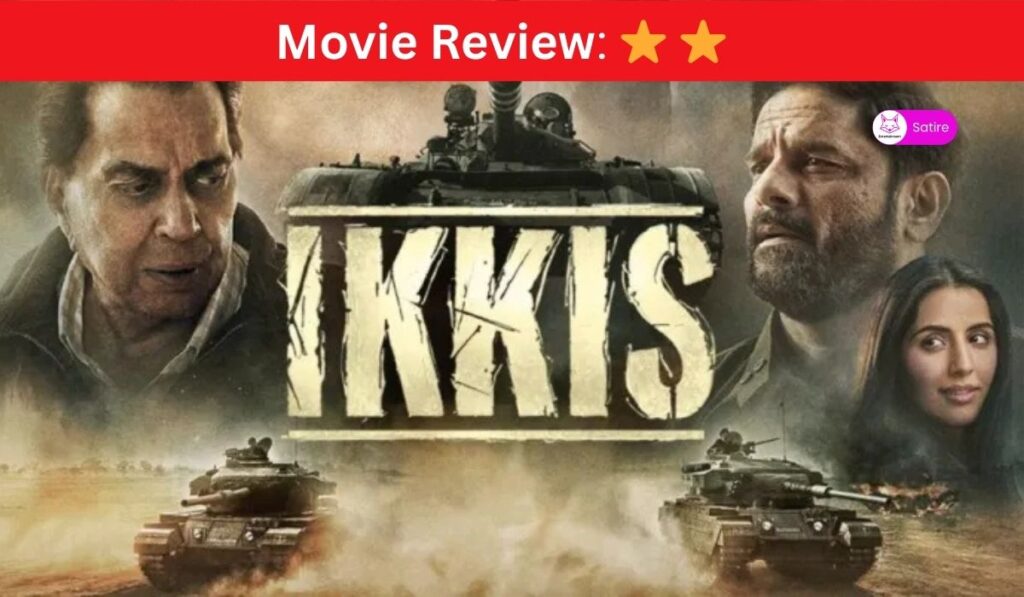
Maddock Films’ Ikkis, based on the life of Param Vir Chakra awardee Shahid Arun Khetarpal, arrives in theatres amid expectations of a powerful war drama. Instead, the film positions itself firmly as an anti-war narrative, choosing moral equivalence over battlefield realism.
While the Indian Army liberated Bangladesh from Pakistan in 1971, Ikkis seems more interested in liberating audiences from the idea of heroic war cinema altogether.
To clarify, the criticism here is not directed at Shahid Arun Khetarpal, but at how Bollywood handles his legacy.
Not a War Film, But a Message Film
Ikkis is not a war movie in the conventional sense. It delivers a familiar message: Indians and Pakistanis are essentially the same, soldiers on both sides are merely following orders, no one is truly at fault, and war only results in loss on both ends.
Audiences expecting Border-style action — explosions, aerial strikes, bullets flying, and visceral combat — are likely to be disappointed. The experience reportedly mirrors the disappointment felt by Dhruv Rathee after watching Dhurandhar, followed closely by the disappointment of his audience after watching his reaction video.
Unsurprisingly, viewers who criticised Dhurandhar for portraying Pakistan negatively may find Ikkis more aligned with their worldview. Maddock Films’ Dinesh Vijan, hailed as a “visionary” for creating the Maddock Horror Universe, appears to have listened closely to India’s most vocal, unpaid, and self-declared neutral critics. The result is a film that pushes as far as possible toward a pro-Pakistan tone within today’s political climate — even though parts of the underlying plot remain historically grounded.
Casting: Mostly Right, One Big Miss
The casting director largely gets it right. Veterans like Dharmendra, along with Jaideep Ahlawat, Vivian Shah, and Rahul Dev, fit seamlessly into their roles.
Jaideep Ahlawat, playing a Pakistani commander who deeply respects Arun Khetarpal, once again proves his omnipresence in Indian cinema. His role carries a supposed suspense reveal, though the outcome is described as highly predictable — on par with the inevitability of certain Bollywood flops or annual personal disappointments.
The casting falters badly, however, in the most crucial role.
Agastya Nanda and the Art of Doing Nothing
Agastya Nanda, portraying Shahid Arun Khetarpal, delivers a performance that has been widely described as emotionally flat. Across scenes of joy, anger, grief, or motivation, the expression and vocal tone remain unchanged, giving the impression of a cardboard cut-out rather than a war hero.
The performance is so restrained that it allows supporting actors — and even a German Shepherd — ample space to shine. Industry observers jokingly suggest that whenever Agastya Nanda had no dialogue, a mannequin could have comfortably replaced him.
Another nepo actor, Sikandar Kher, playing war hero Sagat Singh, fares significantly better. His performance is confident and engaging, with interactions that feel natural — largely because the lead actor leaves plenty of room by opting not to act.
Modern Abstract Acting?
Agastya Nanda’s performance appears to introduce a new genre altogether — modern abstract acting. Much like modern art, the audience is left to guess what emotion they are supposed to feel in each scene. Anger, sadness, inspiration — all are left to viewer interpretation, with the assurance that lineage will handle the rest.
One notable dialogue illustrates this gap clearly: when gifted a golf set and asked whether he plans to play golf on the battlefield, the character replies, “After the war, in Lahore.” The line, loaded with intent, reportedly fails to land due to delivery.
An Underwhelming Climax
Despite featuring several legendary war heroes such as Hanut Singh and Sagat Singh, the film struggles to showcase their bravery effectively. The climax, in particular, is described as severely underwhelming — heavy on build-up, light on payoff, and ending just when the audience expects the real confrontation to begin.
Final Verdict
Ikkis sets out to inspire patriotism but leaves audiences with frustration instead. Viewers walking into theatres expecting renewed respect for Indian soldiers and a surge of national pride may walk out with anger — directed squarely at Bollywood and Maddock Films for mishandling a national hero’s story.
In trying too hard to appear balanced, Ikkis forgets the very reason it exists: to honour sacrifice, not dilute it.